Ethernet won’t be replaced anytime soon, despite advances in wireless technology. While Wi-Fi 6 and 5G offer impressive speeds up to 9.6 Gbps and 10 Gbps respectively, they can’t match Ethernet’s reliability, consistent performance, and security benefits. Enterprise environments continue to rely on Ethernet’s predictable low latency (under 1ms) for critical applications. The future points toward hybrid networks that leverage both technologies, with Ethernet remaining the backbone as speeds advance to 400 Gbps and beyond. The coming sections explore why this venerable technology maintains its dominance.
The Evolution of Ethernet: From 10 Mbps to 400 Gbps
Since its introduction in the 1980s, Ethernet has undergone a remarkable transformation in speed and capability. The original standard delivered just 10 Mbps over coaxial cable, a speed that seemed impressive at the time but is inadequate for today’s demands.
By the mid-1990s, Fast Ethernet pushed speeds to 100 Mbps, while Gigabit Ethernet arrived shortly after. This tenfold increase pattern has continued steadily through the decades.
Today’s data centers and enterprise networks deploy 10G, 40G, and even 100G Ethernet connections routinely. The IEEE’s latest standards support 200 Gbps and 400 Gbps implementations, with future iterations targeting terabit speeds.
You’ll find these advancements have been achieved through improved cabling, better encoding techniques, and more sophisticated signal processing methods.
Wireless Contenders: How Wi-Fi 6 and 5G Measure Up
While Ethernet dominates wired networking, wireless technologies continue to evolve as potential alternatives.
Wi-Fi 6 (802.11ax) delivers theoretical speeds up to 9.6 Gbps, though real-world performance typically reaches 1-2 Gbps. You’ll notice considerable improvements in congested environments, with better multi-device handling than previous Wi-Fi generations.
5G technology promises up to 10 Gbps in ideal conditions, but practical speeds often range from 100-900 Mbps. Its ultra-low latency (as low as 1ms) makes it compelling for time-sensitive applications.
Despite these advances, both wireless options still face reliability challenges. Signal interference, physical obstacles, and distance limitations can disrupt connections.
They also can’t match Ethernet’s consistent performance, especially in enterprise environments where stability is critical.
The Unmatched Benefits of Wired Connectivity in Critical Applications
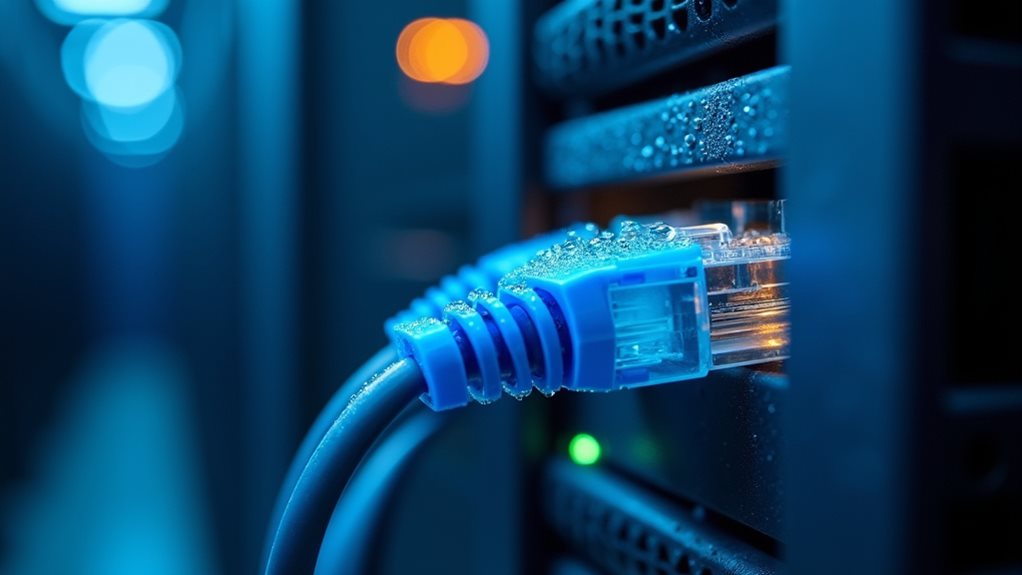
Despite the rapid advancement of wireless technologies, Ethernet connections remain the gold standard for essential applications where reliability can’t be compromised.
Healthcare systems, financial institutions, and industrial control environments continue to depend on wired connectivity’s consistent performance.
When you’re operating mission-critical systems, Ethernet provides several key advantages.
Latency remains predictable and low, typically under 1ms compared to wireless alternatives that often experience variable delays.
Ethernet’s consistent sub-millisecond latency creates the performance certainty that mission-critical applications demand.
Security represents another vital benefit.
Physical connections eliminate many vulnerabilities inherent to wireless transmission, making data interception considerably more difficult for malicious actors.
Power delivery capabilities through Power over Ethernet (PoE) technology also enable simpler deployments for devices like security cameras and access points, eliminating the need for separate power sources while maintaining network connection reliability.
Emerging Technologies That Could Challenge Ethernet’s Dominance
Several emerging technologies are positioning themselves as potential challengers to Ethernet’s long-standing dominance in the networking world.
5G and advanced wireless technologies promise multi-gigabit speeds with increasingly lower latency, making wireless solutions viable for applications traditionally reserved for wired networks.
Li-Fi, which transmits data using light waves, theoretically offers speeds up to 100 times faster than Wi-Fi with improved security benefits.
Quantum networking, still in its early research stages, could revolutionize data transmission with unparalleled security and speed capabilities.
Silicon photonics integrates optical components with traditional electronics, potentially delivering dramatic advancements in data center connectivity while reducing power consumption.
Despite these innovations, each technology faces considerable implementation challenges that have allowed Ethernet to maintain its position as networking’s foundation.
The Future Landscape: Hybrid Networks and Ethernet’s Continued Relevance
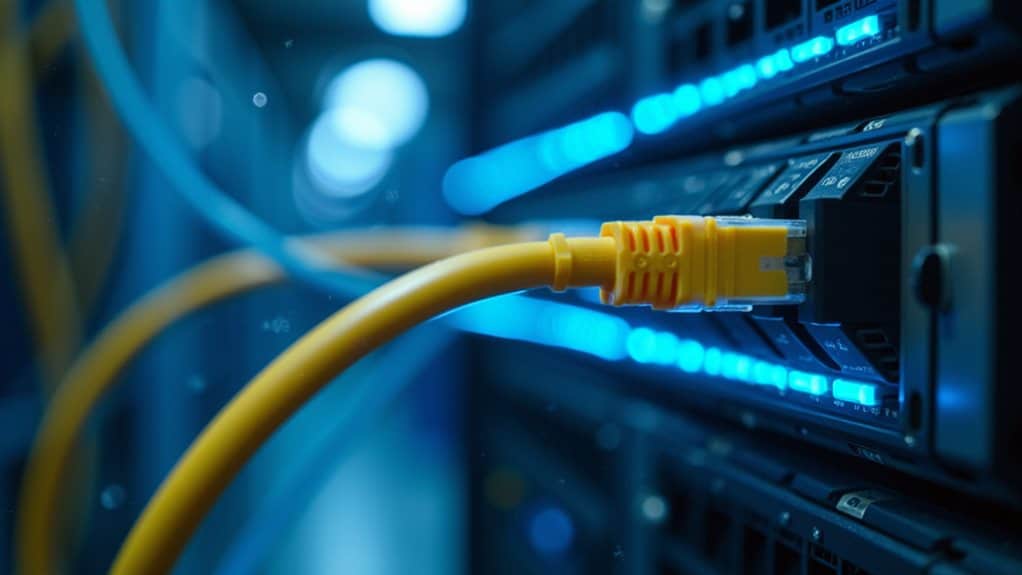
As we look toward the future of networking infrastructure, hybrid solutions that combine Ethernet with newer technologies are emerging as the most practical approach for modern organizations.
Rather than a complete replacement, you’ll likely see Ethernet evolving and integrating with wireless technologies like Wi-Fi 6, 5G, and advanced optical networks. These hybrid environments will leverage Ethernet’s reliability while incorporating the flexibility of newer protocols.
Enterprise networks are already adopting this mixed approach, maintaining Ethernet backbones while implementing wireless solutions at the edge.
The IEEE continues to develop faster Ethernet standards, with 400 Gbps already available and 800 Gbps in development.
Ethernet’s fundamental architecture allows it to adapt while maintaining backward compatibility—a vital advantage for businesses with established infrastructure.
This adaptability suggests Ethernet will remain a core networking technology for decades to come.
Frequently Asked Questions
Is Ethernet Installation Difficult for the Average Home User?
You’ll find Ethernet installation fairly straightforward. You’ll need to run cables between devices and your router, which can be tricky if walls separate them, but pre-made cables make the actual connections simple.
How Much Does Upgrading to Faster Ethernet Infrastructure Typically Cost?
You’ll spend $50-100 for a gigabit router, $15-30 per cable, and $20-50 per network switch. High-speed Cat 6/6a/7 cables cost more. Enterprise-level upgrades can run thousands of dollars depending on scale.
Can Ethernet Cables Be Safely Run Outdoors Between Buildings?
Yes, you can run ethernet cables outdoors between buildings safely, but you’ll need special UV-resistant, weatherproof cables designed for exterior use. Consider using conduit for added protection and check local building codes first.
How Does Ethernet Performance Degrade Over Long Cable Distances?
You’ll notice signal degradation beyond 100 meters for Cat5/6 cables. Attenuation increases, causing data errors and slower speeds. For longer distances, you’ll need signal boosters, fiber optics, or specialized Ethernet extenders.
Are There Environmental Concerns With Ethernet Cable Manufacturing and Disposal?
Yes, you’ll find environmental issues with Ethernet cables. They contain plastics, copper, and flame retardants that aren’t biodegradable. Their manufacturing uses resources, and improper disposal contributes to electronic waste problems worldwide.
Final Thoughts
You’ll likely see Ethernet remain a foundational technology for decades to come, even as wireless options expand. Its reliability, security, and ever-increasing speeds make it irreplaceable for critical infrastructure and data centers. While new technologies will emerge to complement it, Ethernet won’t disappear but evolve. The future isn’t about replacement but integration—creating hybrid networks where Ethernet continues to form the backbone of our connected world.