No, Synology is not a Chinese company. It’s a Taiwanese corporation founded in 2000 by former Microsoft executives Cheen Liao and Philip Wong. Headquartered in Taipei, Taiwan, Synology operates as an independent entity under Taiwan’s regulatory framework. While the company does manufacture some products in mainland China (like many tech firms), its corporate identity, governance, and operational control remain Taiwanese. This distinction carries implications for data security and international business relationships.
Synology’s Taiwanese Origins and Corporate Headquarters
Despite what some may assume, Synology isn’t a Chinese company but rather a Taiwanese corporation. The company was founded in January 2000 by two former Microsoft executives, Cheen Liao and Philip Wong.
Synology’s global headquarters is located in Taipei, Taiwan, where they manage their worldwide operations and direct their product development initiatives. This location serves as the center for their corporate strategy and business administration.
The company has expanded globally while maintaining its Taiwanese roots. Synology has established regional offices in several countries, including the United States, United Kingdom, Germany, France, Japan, and China, to better serve their international customer base.
Taiwan’s distinct political status and separate economic identity from mainland China are important distinctions when considering Synology’s corporate origin.
The Common Misconception: Why Synology Is Often Labeled as Chinese
You might encounter confusion about Synology’s origins due to common misidentification of Taiwanese companies as Chinese in media and public discourse.
News outlets sometimes incorrectly label Synology as Chinese, perpetuating this misconception despite the company’s clear Taiwanese identity.
Many people mistakenly assume Synology’s headquarters are in China rather than their actual location in Taipei, Taiwan, which further contributes to this widespread misunderstanding.
Common Origin Confusion
Why do so many people mistakenly believe Synology is a Chinese company? The confusion stems primarily from geographical and cultural misunderstandings about East Asian countries.
Many Western consumers struggle to differentiate between Taiwan and mainland China, despite their distinct political and economic systems.
The misconception typically arises from several factors:
- Synology’s manufacturing facilities in China lead many to assume Chinese ownership, overlooking that global tech companies commonly produce hardware there.
- The company name sounds Asian to Western ears, creating an automatic association with China as the region’s largest economy.
- Taiwan’s complex political status and China’s claims over it blur distinctions for those unfamiliar with East Asian geopolitics.
This confusion represents a broader pattern of Western misconceptions about Asian business ownership and national origins.
Media Misrepresentation Issues
How frequently do media outlets and tech publications incorrectly label Synology as a Chinese company? This misrepresentation appears surprisingly often in technology reporting, creating persistent confusion among consumers and business customers.
Several factors contribute to this media error. Tech journalists sometimes confuse Synology with other Asian tech manufacturers or make geographical assumptions based on manufacturing locations.
These mistakes then propagate across publications when writers reference each other’s work without fact-checking.
Industry reports occasionally group companies by regional markets rather than headquarters location, inadvertently placing Synology in the Chinese technology sector.
This categorization error spreads through financial news and market analysis.
You’ll also notice that product review sites sometimes include incorrect company information in standardized company profiles, perpetuating the misunderstanding even when the main review content is accurate.
Headquarters Location Misunderstanding
Despite being headquartered in Taiwan, Synology is frequently mislabeled as a Chinese company due to widespread geographical confusion about East Asian countries. This misunderstanding stems from several factors including political complexities and international relations.
The confusion about Synology’s headquarters location often leads to:
- Misrepresentation in media reports where Taiwan-based companies are incorrectly described as Chinese
- Consumer misconceptions that affect purchasing decisions based on incorrect country-of-origin information
- Unnecessary concerns about data security when users wrongly associate the company with Chinese data regulations
Synology officially maintains its global headquarters in Taipei, Taiwan, with regional offices in several countries. This distinction is important because Taiwan operates under different business regulations, governance, and international trade relationships than mainland China.
Taiwan vs. China: Understanding the Geopolitical Distinction
Taiwan and China have existed as separate political entities since 1949, when the Chinese Civil War effectively created two governments.
Taiwan functions as a self-governing democracy with its own constitution, military, and elections, though its sovereign status remains contested internationally.
You’ll find that while Taiwan maintains diplomatic relations with only a limited number of countries, it operates independently in practice, creating considerable political complexities that affect how Taiwanese companies are categorized globally.
Historical Political Separation
To fully understand Synology’s origins, you’ll need to grasp the complex historical separation between Taiwan and mainland China.
The two territories have been governed separately since 1949, when the Chinese Civil War resulted in the Republic of China (ROC) government retreating to Taiwan.
Since then, Taiwan has developed as a self-governing democracy with its own:
- Constitution, democratically elected government, and independent judiciary system
- Separate economic development path, becoming a global technology hub
- Distinct national identity that has evolved differently from mainland China
This separation forms the backdrop for companies like Synology, which was founded and operates in Taiwan.
While mainland China considers Taiwan a breakaway province, Taiwan functions as a de facto independent state with its own political system, economy, and international relationships.
Taiwan’s Sovereign Status
When examining Taiwan’s sovereign status, it’s essential to recognize the complex international position the island occupies.
Taiwan functions as a self-governing democracy with its own elections, military, currency, and diplomatic relationships. However, only 13 countries formally recognize Taiwan as an independent nation.
Most major powers, including the United States, maintain unofficial relations with Taiwan while acknowledging China’s position. This creates a unique “strategic ambiguity” in international politics.
The People’s Republic of China claims Taiwan as a breakaway province under its “One China” policy and opposes any actions suggesting Taiwan’s independence. China has increased diplomatic and economic pressure on countries that strengthen ties with Taiwan.
This geopolitical distinction matters when discussing companies like Synology, as their national origin carries political implications.
International Recognition Complexities
The international recognition of Taiwan exists in a gray area that impacts companies operating in the region. Most countries don’t officially recognize Taiwan as an independent nation, instead maintaining informal relations while acknowledging the “One China” policy.
This complex status creates several challenges:
- Taiwanese companies must maneuver careful diplomatic language when expanding internationally.
- Products manufactured in Taiwan might be labeled as “Made in Taiwan, ROC” or simply “Made in Taiwan” to avoid controversy.
- International business partnerships often require strategic wording in contracts and public communications.
Companies like Synology operate within this intricate framework, maintaining their Taiwanese identity while conducting global business.
Understanding this distinction helps clarify why a Taiwanese company isn’t technically Chinese, despite China’s territorial claims over Taiwan.
Synology’s Manufacturing and Supply Chain Connections
While Synology is headquartered in Taiwan, the company’s manufacturing and supply chain operations extend across Asia. Their production facilities include sites in mainland China, where many of their hardware components are assembled.
Synology sources parts from various global suppliers but maintains notable manufacturing partnerships within China’s technology ecosystem. This arrangement allows the company to leverage cost efficiencies while maintaining their quality control standards.
Synology balances global sourcing with strategic Chinese manufacturing partnerships to optimize costs without compromising quality.
It’s worth noting that this manufacturing approach is common among technology companies worldwide. Like many tech firms, Synology designs their products in-house but utilizes regional manufacturing capabilities for production.
The company maintains control over their intellectual property and software development, which primarily occurs at their Taiwan headquarters, while benefiting from established supply chain networks throughout the greater Asia region.
Data Security Implications of Synology’s National Identity
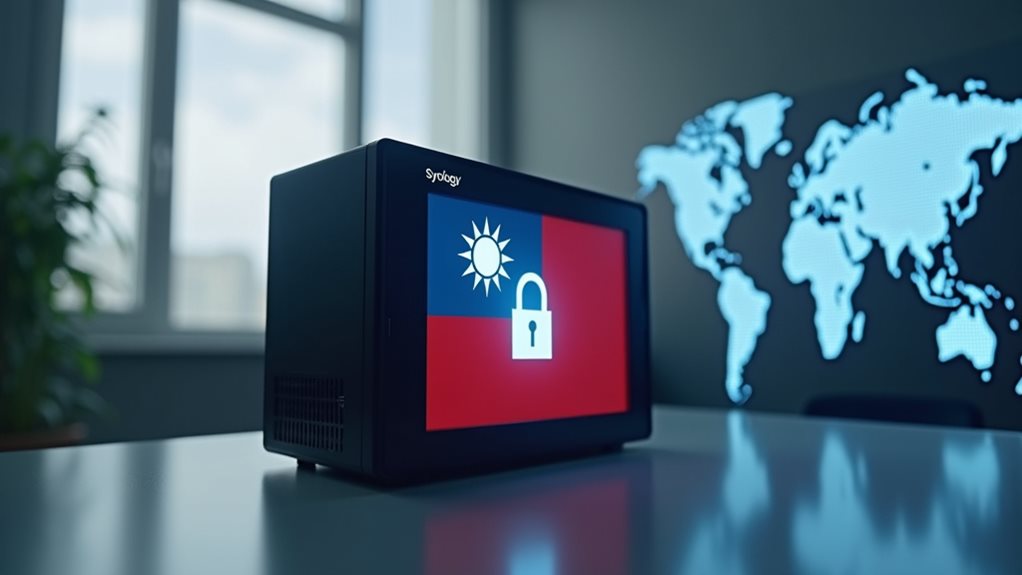
Given Synology’s Taiwanese headquarters and identity, many users wonder about potential data security implications in today’s complex geopolitical environment.
Synology operates under Taiwan’s regulatory framework, which maintains different data protection standards than mainland China.
- Taiwan’s legal system provides stronger intellectual property protections and privacy safeguards than those found in mainland China.
- Synology’s NAS devices process and store data locally on your hardware, not on remote servers potentially subject to foreign data access laws.
- The company’s transparency about security updates and vulnerability disclosures helps users make informed decisions about protecting their data.
When reviewing Synology products, understanding the distinction between Taiwan and China matters for evaluating potential data sovereignty concerns.
The company’s Taiwanese identity influences its approach to user privacy, security implementations, and compliance with international data protection standards.
How Synology’s Taiwanese Status Affects Global Technology Partnerships
As a Taiwanese company, Synology’s national identity significantly shapes its global technology partnerships and international business relationships.
Synology’s Taiwanese status allows it to foster partnerships with Western technology companies without the data security concerns that often accompany Chinese firms. This positioning helps the company establish trust in markets like North America and Europe.
Operating from Taiwan gives Synology a trust advantage in Western markets that Chinese competitors simply cannot match.
You’ll find that Synology can manage international trade relationships differently than mainland Chinese companies. They aren’t subject to the same restrictions or tariffs that may affect Chinese tech firms during trade disputes.
The company leverages its Taiwanese identity to position itself as a global brand rather than a regional one. This status enables Synology to develop technology partnerships across diverse markets while maintaining independence from China’s regulatory environment.
Frequently Asked Questions
How Does Synology’s Pricing Compare to Other NAS Manufacturers?
You’ll find Synology’s pricing higher than budget brands like TerraMaster but competitive with QNAP and Asustor. They offer better software value, making their premium price worthwhile for home and small business users.
What Warranties Does Synology Offer for Their Products?
Synology offers standard 2-3 year warranties for most of their NAS devices. You’ll get 5-year warranties on their enterprise products. If you want extended coverage, you can purchase additional warranty extensions for certain models.
Can Synology Devices Work With Both Windows and Mac Systems?
Yes, your Synology devices can work seamlessly with both Windows and Mac systems. They’re designed for cross-platform compatibility, allowing you to access, manage, and share your files regardless of which operating system you’re using.
Does Synology Offer Cloud Storage Alternatives to Their Physical NAS?
Yes, Synology offers C2 Storage, their cloud storage service that’s an alternative to physical NAS devices. You’ll find various subscription plans with different storage capacities to meet your needs without requiring hardware maintenance.
How Frequently Does Synology Release Software Updates for Older Devices?
Synology typically releases DSM updates for older devices quarterly, with security patches more frequently. You’ll get major firmware upgrades for about 5-7 years, though your older NAS may eventually reach end-of-support status.
Final Thoughts
You’ve now learned that Synology is a Taiwanese company, not Chinese as often misunderstood. This distinction matters for both geopolitical accuracy and potential security considerations. While Taiwan and China have complex relations, recognizing Synology’s Taiwanese headquarters and identity provides clarity about where your data storage solutions originate. Understanding this fact helps you make more informed decisions about the technology products you choose to trust.