Binoculars have always rewarded observation skills. The best pairs disappear in the hands as you scan a tree line, follow a soaring raptor, or track a warbler through dappled light. For decades, they stayed simple and dependable while cameras, watches, and phones absorbed the smart features. That divide is closing.
At Pepcom during CES 2026, and again on the floor at IFA 2026 in Berlin, MatataLab’s MatataXplore division showed the Solvia ED 8×32 AI binoculars. The pitch is straightforward. Keep what makes binoculars invaluable in the field, then layer in on-device bird identification, a coaxial camera that captures what you see, a touchscreen for quick control, and app-based sharing when you want it. The result aims to reduce friction between seeing and documenting, without demanding you learn a new gadget’s quirks while a bird slips away.
This deep dive looks at what Solvia brings to the field, why its approach differs from past attempts, who it suits best, and how it fits into the broader rise of AI in outdoor optics.
Optics-first design with the classic 8×32 balance
Solvia starts with a proven formula. The 8×32 configuration is a staple for birders and naturalists because it balances magnification, brightness, field of view, and portability. Extra-low dispersion glass reduces chromatic aberration so edges stay crisp and color fringing is minimized. That matters when you are scanning fast-moving subjects or working in mixed light. It means less eye fatigue and more time observing.
Two complementary technologies round out the viewing and capture experience. Wide Dynamic Range helps preserve detail in high-contrast scenes so a backlit songbird does not collapse into shadow and blown highlights. Electronic Image Stabilization smooths handheld video capture while leaving the optical view natural. The emphasis is consistent with the product’s promise. Get the glass right first, then let compute enhance capture rather than overwhelm the viewing experience.
A camera that finally aligns with what you see
Field documentation is only useful if your captures reflect what you actually saw. Solvia’s patented coaxial optical design aligns the camera’s imaging path with the binoculars’ optical axis. In practice, that means the framing in your shot matches what your eyes see through the barrels. Anyone who has tried to clip a smartphone to an eyepiece knows how often misalignment ruins a moment. This alignment is a subtle but significant improvement because it lets you transition from observation to capture without fighting a second device.
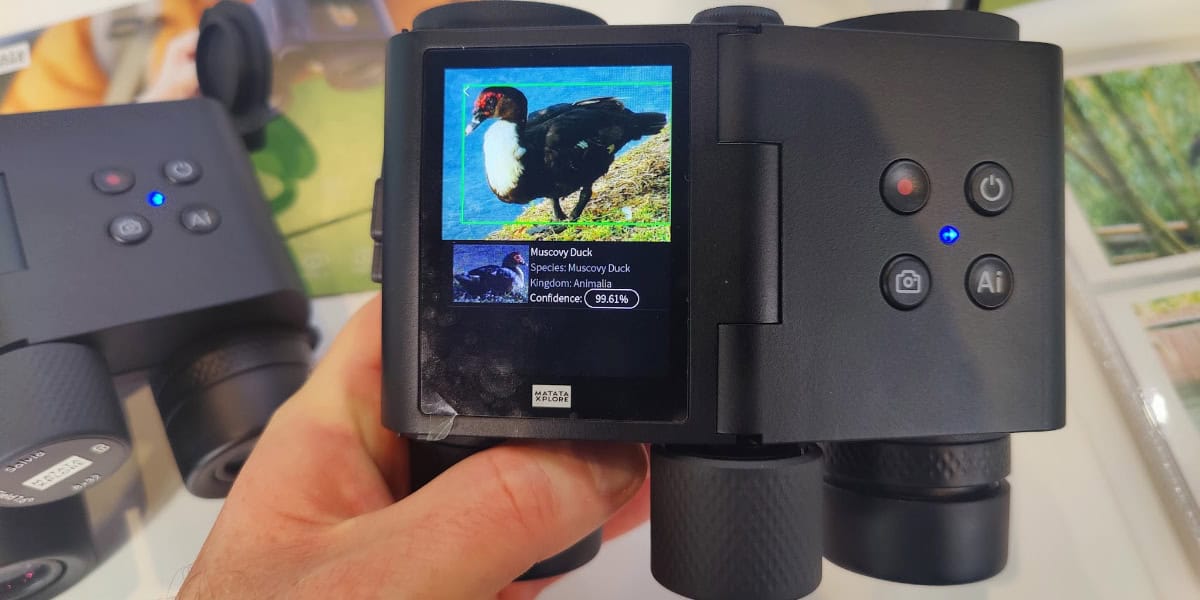
The integrated camera works with a 2.8 inch touchscreen that sits within a familiar binocular workflow. You observe, decide whether to capture, then tap or press to record a still or video. The goal is not to turn binoculars into a camera, but to let capture happen within the flow of observation.
On-device AI that works where the trails lead
The headline feature is on-device bird identification. With a single press, the binoculars run a local model that can identify birds in roughly one second under favorable conditions. Because the model runs offline, it remains useful in remote habitats and along coastal or mountain routes where mobile coverage drops. That offline operation also keeps many interactions private and on-device by default.
When you do have connectivity, the companion app expands the device’s range. It can use cloud models to identify plants and other wildlife and it supports live view streaming to companions. That turns solo sightings into shared moments. It also supports guided walks and education, letting groups see what the spotter sees in real time.
Rugged build for real-world use
Smart features mean little if the device struggles outside the conference hall. Solvia weighs around 560 g so it is still a comfortable carry for all-day hikes. The body is IP64 rated and nitrogen filled to resist dust, splashes, and fogging. The company rates battery life for full-day outings, which aligns with typical fieldwork or long birding sessions.
A modular approach adds practical options. Optional expansion includes GPS for geotagging, an electronic compass for bearings, and an auxiliary light for low-light inspection. These are not flashy add-ons. They are the kinds of tools that reduce the number of separate devices you need to pack and manage in the field.
From classroom insight to field utility
MatataLab’s roots are in AI-enabled educational hardware. With MatataXplore, the team extends that experience to outdoor tools. The design choices show an emphasis on reducing cognitive load. The bird identification is one press away. The camera captures what you saw instead of asking you to wrestle with mounts or adapters. The app is there when you need broader ID coverage or sharing, and it steps out of the way when you do not.
That practical framing showed during hands-on demos at CES and IFA. Attendees paid close attention to how quickly they could go from viewing to capturing and how much the tech interfered with the rhythm of observation. The big takeaway was that Solvia’s features did not demand attention when you needed to keep your eyes on the subject.
Where Solvia stands in the smart optics landscape
Swarovski’s AX Visio, launched earlier in the decade, set the template for what premium smart binoculars can do. It blends high-end sport optics with AI identification and a companion app, and it introduced useful guidance features to help a companion find what you are seeing. It also sits at a premium price point that puts it out of reach for many users.
Solvia’s approach targets accessibility and consolidation. It offers strong 8×32 optics, a coaxial camera that reduces friction, reliable offline bird identification, and a workflow that keeps you in the moment. The goal is to bring smart binoculars to more packs and more trailheads, not just to professional guides or those investing in top-tier optics.
This positioning also fits broader trends. Smart bird feeders popularized AI identification in backyard habitats and showed there is demand for automated ID. Solvia effectively takes that logic into the wild where a fixed camera on a feeder is not an option and where real-time identification has to be compact, durable, and less dependent on connectivity.
Strengths and trade-offs
Strengths
- Offline bird identification that works without network access.
- Balanced 8×32 optics with ED glass for natural, sharp viewing.
- Coaxial optical design so captures match what you see.
- Rugged, lightweight build with IP64 and nitrogen fill for field reliability.
- All-day battery suitable for typical field days.
- App-enabled sharing and cloud-based ID for plants and other wildlife when connectivity is available.
- Optional modules for GPS, compass, and auxiliary lighting.
Trade-offs
- No AI is perfect. Challenging conditions such as heavy backlighting, partial occlusion, or juvenile plumages can reduce identification confidence.
- Integrated cameras add complexity. Some users may still prefer a pure optical instrument and a separate camera for documentation.
- Responsible use is essential. Live streaming and instant sharing are powerful, but they must be balanced with habitat sensitivity and privacy norms.
Practical guidance by user type
- Birders building skills: Treat the offline ID as a coach. Use it to narrow possibilities and check your conclusions, then confirm with field marks, behavior, and habitat. The integrated camera is ideal for quick record shots to accompany checklists and trip notes.
- Guides and educators: Real-time sharing and aligned capture simplify instruction. The optional GPS and compass help log routes and orient learners to a sighting. The offline model supports remote field sessions where connectivity is poor.
- Creators and conservation storytellers: The coaxial camera, WDR, and EIS reduce capture friction in changing light. The app shortcuts the path from field capture to post-ready clips when schedules are tight.
- Hikers and nature enthusiasts: You get a high quality 8×32 with a helpful assistant on tap. The device remains practical even if you never use the app in the field and only sync later.
CES and IFA 2026 set the stage
Showcasing at Pepcom during CES 2026 introduced Solvia to a broad tech audience and invited scrutiny of its optical alignment and offline AI. Presenting again at IFA 2026 in Berlin put the device in front of a global consumer electronics crowd that increasingly expects intelligence to be integrated, not bolted on. Together, these events signal that smart binoculars are moving from curiosity to category. The conversation is no longer whether AI belongs in binoculars. It is how to add intelligence in a way that respects what makes binoculars valuable in the first place.
The bigger picture for field optics
Solvia ED 8×32 suggests a measured path for merging optics and compute. The binocular remains a trusted tool for seeing, while the camera and AI simply shorten the path from seeing to understanding and sharing. That shift will shape norms. Identification assistance should complement, not replace, fieldcraft. Sharing should respect sensitive species and sites. Offline-first design helps by default since it keeps many processes on the device, but the wider community will set expectations through use.
If you care about the craft of field observation, Solvia’s promise is appealing. It brings the benefits of AI and integrated capture to a familiar 8×32 format in a device that feels built for mud, spray, and long trails. It is not a gadget in your pocket competing with your phone. It is a binocular that respects the moment and quietly helps you make more of it.
Bottom line
Solvia ED 8×32 AI binoculars combine capable optics, a camera that truly matches your view, offline bird identification, and a rugged build. The result is a practical field instrument that reduces the friction between observation and documentation. With back-to-back appearances at CES and IFA 2026, Solvia positions itself as an accessible bridge into smart binoculars for birders, educators, guides, and outdoor creators who want intelligence that serves the craft of seeing rather than distracting from it.