Managing a handful of network-attached storage devices can be straightforward. Managing them across multiple departments or business locations is another matter. Firmware updates, account administration, security settings, and routine maintenance can mean repeating the same work on device after device.
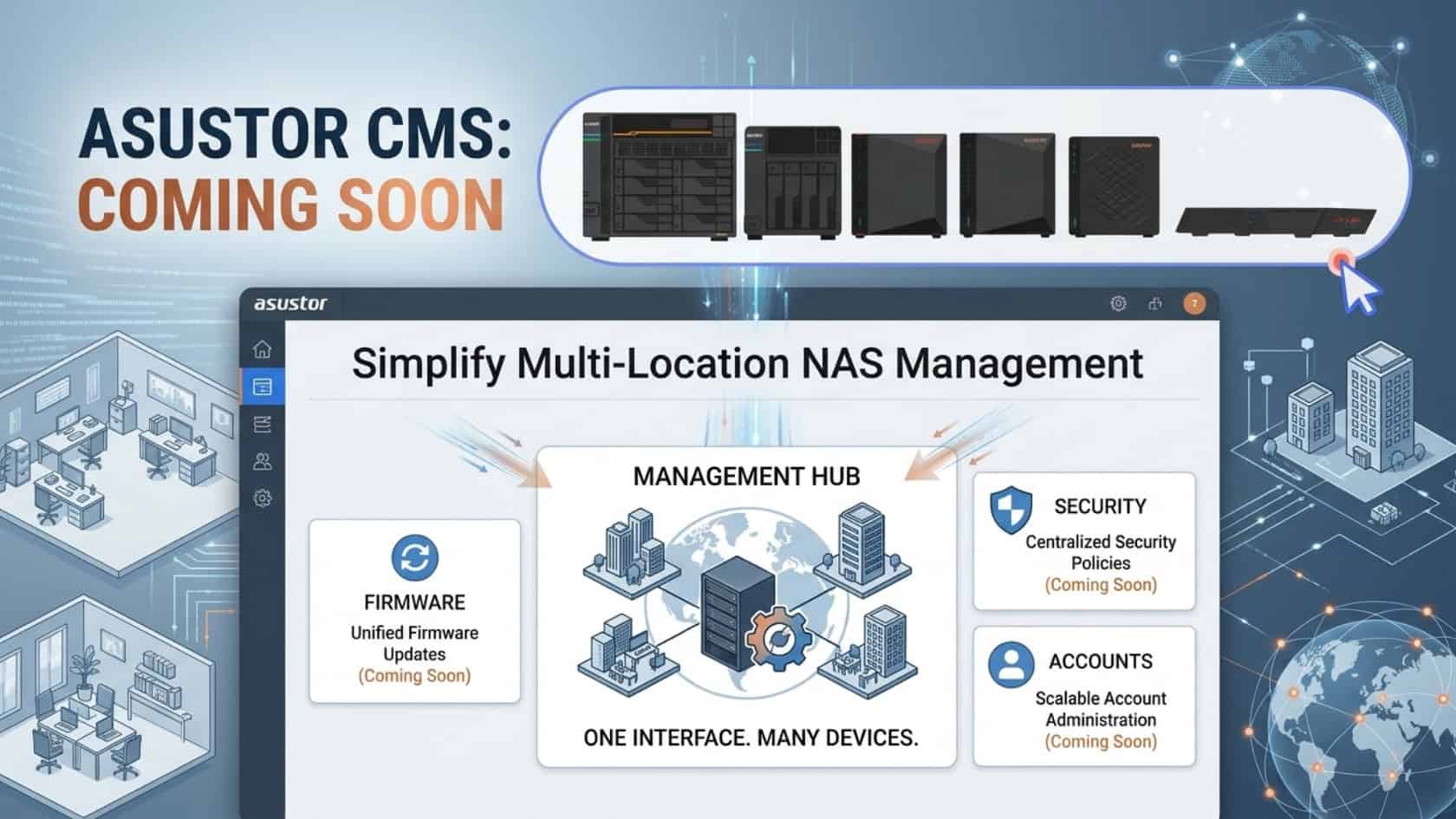
ASUSTOR is preparing to address that challenge with ASUSTOR CMS, a centralized management tool designed to help IT teams deploy, maintain, and update multiple ASUSTOR NAS devices from one interface. The company says the solution is coming soon and is intended to make large-scale NAS administration more efficient and consistent.
From repeated logins to central control
For IT engineers, the burden of managing a distributed NAS fleet often lies in the repetition. Each device may need to be accessed individually to apply updates or adjust its configuration. That takes time, and inconsistent settings can leave gaps in an organisation’s security.
ASUSTOR CMS is designed to bring these tasks together in a central console. Rather than repeatedly logging into separate devices, administrators can monitor and manage their NAS infrastructure from a single homepage. The aim is to simplify routine work while helping teams maintain a more consistent approach across their deployments.
Faster onboarding and clearer device organisation
A key part of the proposed system is zero-touch onboarding. According to ASUSTOR, administrators can enter the login credentials for target devices and use the central system to install the required agents remotely. This is intended to avoid configuring each device by hand or relying on complex setup tools.
Once devices are connected, tags can help administrators organise them by department, region, or purpose. Tags can be added, edited, and removed in groups, while filtering lets teams identify the devices they need to target. That organisation can help reduce the risk of sending a command to the wrong NAS when managing a large fleet.
Routine maintenance in batches
ASUSTOR CMS is also designed to handle several everyday maintenance tasks remotely. Administrators will be able to create and configure shared folders, distribute ADM firmware upgrades to multiple devices, and carry out batch power operations such as rebooting or shutting down NAS units.
The software’s automation script centre is intended to support standardised scripts, with options to run them immediately or save them for later use. Together, these tools could help IT teams apply repeatable procedures across devices instead of performing the same steps manually.
Security controls are another part of the planned feature set. CMS supports batch enabling of auto-block functionality to create blacklists. ASUSTOR says it is planning to expand the platform with one-click controls for enabling or disabling SMB, NFS, FTP, SSH, and SNMP protocols. These are described as planned additions, rather than current capabilities.
App deployment and visibility into tasks
Keeping software consistent across company devices can be challenging, particularly when updates and applications need to be installed at scale. ASUSTOR CMS is set to support both online and manual batch app installations, helping administrators maintain consistent software versions across their NAS fleet.
A task monitoring centre will provide progress and history for batch updates, script distribution, and other tasks that run asynchronously. That visibility matters when commands are sent to many devices: administrators can track what is happening and review whether operations have completed.
ASUSTOR also outlines future expansion for AD/LDAP domain integration settings and energy management aligned with a unified EuP standard. The company says the energy-efficiency approach is intended to help businesses save energy and costs.
A centralised approach to a repetitive job
ASUSTOR CMS is aimed at organisations that need to maintain NAS devices across a wider network. By bringing onboarding, device organisation, routine maintenance, software deployment, and task tracking into one console, it is intended to reduce the time IT teams spend on repetitive administration.
The promised benefit is not only fewer manual steps, but a more organised way to manage a growing NAS environment. With the product still marked as coming soon, its planned additions and final availability remain to be confirmed. For IT teams responsible for many ASUSTOR devices, however, the centralised approach points to a simpler way to handle everyday fleet management.