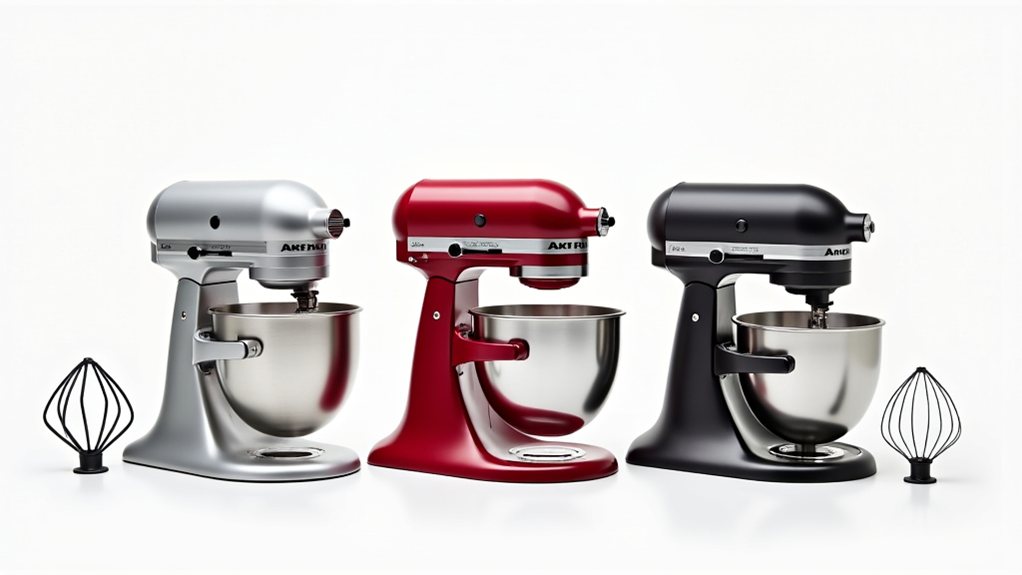
When you’re ready to enhance your baking game, a quality stand mixer becomes a crucial kitchen ally. You’ll find that the right model can transform tedious tasks into effortless processes, saving you valuable time and energy. With countless options available, narrowing down to truly exceptional mixers requires understanding which features actually matter for your specific needs. Let’s examine three standout KitchenAid models that consistently outperform competitors and discover which might be your perfect match in the kitchen.
KitchenAid Classic Series 4.5 Quart Tilt-Head Stand Mixer K45SS, Onyx Black
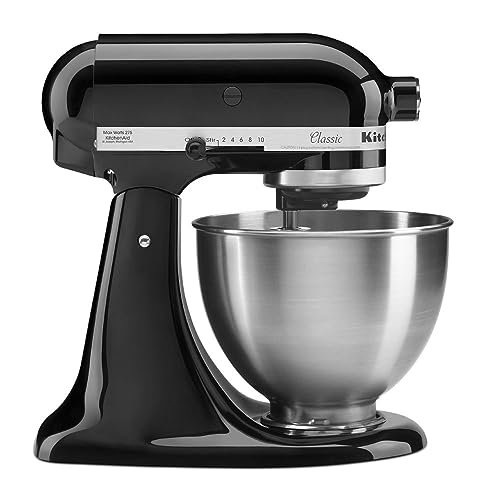

The KitchenAid Classic Series stands as a powerhouse for home bakers who need reliability without breaking the bank. With its durable metal construction and 59 touchpoints, you’ll achieve thoroughly mixed ingredients every time. The 4.5-quart stainless steel bowl handles up to 8 dozen cookies in one batch—perfect for holiday baking marathons.
You’ll appreciate the tilt-head design that provides easy access to your mixture, while the 10-speed settings tackle everything from gentle folding to vigorous whipping. Don’t overlook the versatile power hub, which accepts over 10 optional attachments, transforming your mixer into a pasta maker, ice cream churner, or vegetable spiralizer.
Best For: Enthusiastic home bakers who need a reliable, versatile stand mixer for regular baking projects and want the flexibility to expand their culinary capabilities through additional attachments.
Pros:
- Durable metal construction with 59 touchpoints ensures thorough mixing and long-lasting performance
- Versatile 10-speed settings and included attachments handle everything from delicate folding to heavy dough kneading
- Power hub compatibility with 10+ optional attachments transforms the mixer into a multi-functional kitchen appliance
Cons:
- At 22 pounds, the mixer is relatively heavy and may be difficult to move or store for some users
- 4.5-quart capacity, while sufficient for most home baking needs, might be limiting for very large batches
- Optional attachments that expand functionality are sold separately, adding to the overall investment
KitchenAid Artisan Series 5 Quart Stand Mixer (KSM150PS)

Serious home bakers and cooking enthusiasts will find their match in KitchenAid’s Artisan Series 5 Quart Stand Mixer, a powerhouse that effortlessly handles everything from delicate meringues to dense bread doughs. The tilt-head design gives you easy access to the bowl, while 10 adjustable speeds guarantee precise control for any recipe.
You’ll appreciate the impressive capacity—mix up to 9 dozen cookies in one batch—and the 59 touchpoints around the bowl ensure thorough mixing with no ingredients left behind. The included flat beater, dough hook, wire whip, and pouring shield offer versatility right out of the box.
Best For: Serious home bakers and cooking enthusiasts who regularly prepare moderate to large batches of baked goods and want a versatile, durable stand mixer that can handle everything from delicate batters to dense doughs.
Pros:
- Versatile 10-speed settings with 59 mixing touchpoints ensure thorough incorporation of ingredients for consistent results
- 5-quart capacity handles large batches (up to 9 dozen cookies) while the tilt-head design allows for easy bowl access
- Includes essential attachments (flat beater, dough hook, wire whip, pouring shield) with compatibility for over 10 optional attachments
Cons:
- Relatively heavy at 22.8 pounds, making it difficult to move frequently between storage and workspace
- Premium price point may be cost-prohibitive for casual or beginner bakers
- Takes up significant counter space with its 14.1″ x 8.7″ footprint, requiring dedicated kitchen real estate
KitchenAid Classic Series 4.5 Quart Tilt-Head Stand Mixer K45SS, White

Trusted by home bakers for generations, KitchenAid’s Classic Series 4.5 Quart Tilt-Head Stand Mixer delivers professional-quality results without the professional price tag. With its powerful 275W motor and 10-speed versatility, you’ll handle everything from gentle folding to vigorous whipping with precision.
The durable metal construction features 59 touchpoints around the bowl, guaranteeing thorough ingredient incorporation. You’ll appreciate how the tilt-head design provides easy access to your mixture, while the included coated flat beater, dough hook, and 6-wire whip tackle diverse recipes. The 4.5-quart stainless steel bowl accommodates up to 8 dozen cookies in a single batch, making it perfect for family baking sessions.
Best For: Home bakers who need a reliable, powerful stand mixer for family-sized batches of cookies, breads, and other baked goods without investing in a commercial-grade appliance.
Pros:
- Versatile 10-speed settings allow for precise control when mixing everything from delicate batters to thick dough
- Durable metal construction with 59 touchpoints ensures thorough mixing and long-lasting performance
- Compatible with over 10 optional attachments (sold separately) that transform it into a multi-functional kitchen tool
Cons:
- At 24.2 pounds, the mixer is relatively heavy and may be difficult to move around the kitchen frequently
- 275W motor, while sufficient for most home baking needs, may struggle with very dense doughs compared to higher-powered models
- Premium pricing compared to basic stand mixers, though justified by the quality and brand reputation
Factors to Consider When Choosing Stand Mixers
When you’re in the market for a stand mixer, you’ll need to weigh several essential factors that impact both performance and value. Your ideal mixer should match your specific cooking habits, with considerations like bowl capacity determining how much dough you can prepare at once, while motor power, speed options, construction quality, and available attachments will greatly influence your long-term satisfaction. These elements form the foundation of your decision-making process, helping you steer through the numerous options to find a stand mixer that’ll serve as a reliable kitchen companion for years to come.
Bowl Size and Capacity
Two critical factors that’ll greatly impact your baking experience are the bowl size and capacity of your stand mixer. Most standard mixers offer bowls ranging from 4.5 to 5 quarts, with the difference considerably affecting your productivity. A 4.5-quart bowl handles basic tasks admirably, allowing you to prepare dough for multiple batches of cookies or bread, while the 5-quart option provides that extra space for larger projects.
Consider how often you’ll be baking for crowds—a larger bowl can accommodate ingredients for up to 9 dozen cookies at once. Don’t overlook material quality either; stainless steel bowls provide durability and easy cleaning, especially when they’re dishwasher safe. Finally, evaluate the handle design, as a well-constructed grip will make transferring your mixtures much less cumbersome.
Motor Power
As you dive deeper into the technical aspects of stand mixers, motor power emerges as a crucial element that determines both performance and durability. Measured in watts, this specification ranges from 250 to well over 1000, with higher numbers translating to more muscle for challenging tasks.
For everyday baking, you’ll find that mixers with 500+ watts handle dense doughs and larger batches with ease, while lower-powered models may struggle and overheat. When selecting your ideal machine, consider what you’ll be making most frequently. If bread kneading and heavy batters dominate your culinary repertoire, investing in a more powerful motor will save you frustration and extend your mixer’s lifespan. Remember, a robust motor isn’t just about immediate performance—it’s an investment in longevity, allowing your mixer to work efficiently without strain.
Speed Settings
The perfect stand mixer delivers precision through its range of speeds, making the difference between a delicate meringue and a dense bread dough. With typically 10 speed settings available, you’ll gain remarkable control over your mixing process for any recipe you tackle.
You’ll appreciate how these varied speeds accommodate different kitchen tasks—from a gentle stir for folding in delicate ingredients to high-powered whipping for creating stiff peaks. Look for models that feature gradual speed shifts, which help prevent those frustrating ingredient splatters when you’re starting a mix. The best mixers also incorporate around 59 touchpoints throughout the bowl, guaranteeing thorough mixing at every speed level. This thoughtful design means you won’t find unmixed ingredients hiding at the bottom of your bowl, regardless of whether you’re kneading, mixing, or whipping.
Durability and Construction
Beyond mastering speeds, your stand mixer’s construction will determine how many years of baking joy you’ll experience. Metal-bodied models consistently outperform plastic alternatives in longevity, withstanding the rigors of frequent use without compromising structural integrity.
When examining build quality, pay attention to the mixer’s weight—heavier units often indicate more robust materials that can handle demanding tasks like kneading dense dough. The thoughtful engineering of a tilt-head design can greatly reduce wear on locking mechanisms, extending your appliance’s functional lifespan.
Don’t overlook mixing efficiency when evaluating durability. Mixers with multiple touchpoints around the bowl distribute work more evenly, reducing motor strain during operation. This balanced performance not just enhances your baking results but also prevents premature burnout, guaranteeing your investment continues to deliver reliable performance through countless recipes.
Available Attachments
Savvy home bakers recognize that a stand mixer‘s true value extends far beyond its mixing capabilities, thanks to the power hub that transforms this kitchen workhorse into a multi-functional appliance. With over ten optional attachments available, you’re not merely investing in a mixer—you’re acquiring a versatile culinary tool that can handle everything from pasta making to ice cream churning.
When selecting your stand mixer, consider which attachments align with your cooking style. Do you frequently make bread? A dough hook is crucial. Love fresh pasta? Look for compatible pasta rollers. The ability to add food grinders, vegetable spiralizers, and whisking attachments allows you to customize your mixer to suit your specific needs. Though these attachments are typically sold separately, they greatly improve your mixer’s utility, consolidating multiple kitchen functions into one powerful machine.
Weight and Portability
When selecting your ideal stand mixer, weight considerations present a double-edged sword that shouldn’t be overlooked. Most stand mixers tip the scales between 22 and 24.2 pounds—a heft that serves an essential purpose during operation but might challenge your storage plans.
Heavier models (closer to 24 pounds) anchor themselves firmly to your countertop when kneading dense doughs, preventing the annoying “walking” phenomenon that lighter machines might exhibit. However, if you’re working with limited counter space and need to store your mixer after each use, that same weight becomes a liability. You’ll want to balance stability requirements against your ability to lift and maneuver the appliance regularly. Don’t forget to measure your storage space dimensions too—even a perfectly weighted mixer won’t serve you well if it doesn’t fit in your designated cabinet.
Design and Aesthetics
Three distinctive elements define a stand mixer’s visual impact in your kitchen: color selection, material quality, and overall form factor. With over 20 color options available in some models, you’ll likely find one that perfectly complements your kitchen’s aesthetic. The premium metal construction not only guarantees durability but also adds a sophisticated touch that raises your counter space.
Consider how a mixer’s dimensions will fit within your kitchen layout before purchasing. A tilt-head design offers both practical functionality—allowing easier access to your mixing bowl—and contemporary styling that many home chefs prefer. Don’t overlook thoughtful design features like ergonomic handles and pouring shields, which improve usability without compromising visual appeal. Your stand mixer isn’t just a tool; it’s a statement piece that should balance form and function in your culinary workspace.
Budget and Value
Investing wisely in a stand mixer requires careful consideration of both your budget constraints and long-term value expectations. You’ll find price points ranging from $200 to over $500, with the variation typically reflecting differences in capacity, durability, and included features. When evaluating options, focus on mixers offering 4.5 to 5-quart capacities, which provide versatility for various recipe volumes without overwhelming your counter space.
Don’t overlook construction materials—mixers with metal components generally outlast plastic alternatives and deliver more consistent performance. You’ll also maximize value by selecting models that include crucial attachments rather than requiring costly add-ons later. Before making your final decision, review customer ratings carefully; highly-rated mixers often justify their price tags through superior reliability and performance. Remember, the best value isn’t necessarily the cheapest option, but rather the one that meets your specific needs at a reasonable price.
Final Thoughts
You’ll find that choosing the right KitchenAid mixer depends on your specific baking needs and kitchen capacity. Whether you’re an occasional baker who’ll benefit from the Classic’s reliability, a serious enthusiast requiring the Artisan’s versatility, or a power user needing the Professional’s robust performance, there’s an option that fits your culinary ambitions. Consider your batch sizes, counter space, and long-term baking goals before making this worthwhile kitchen investment.