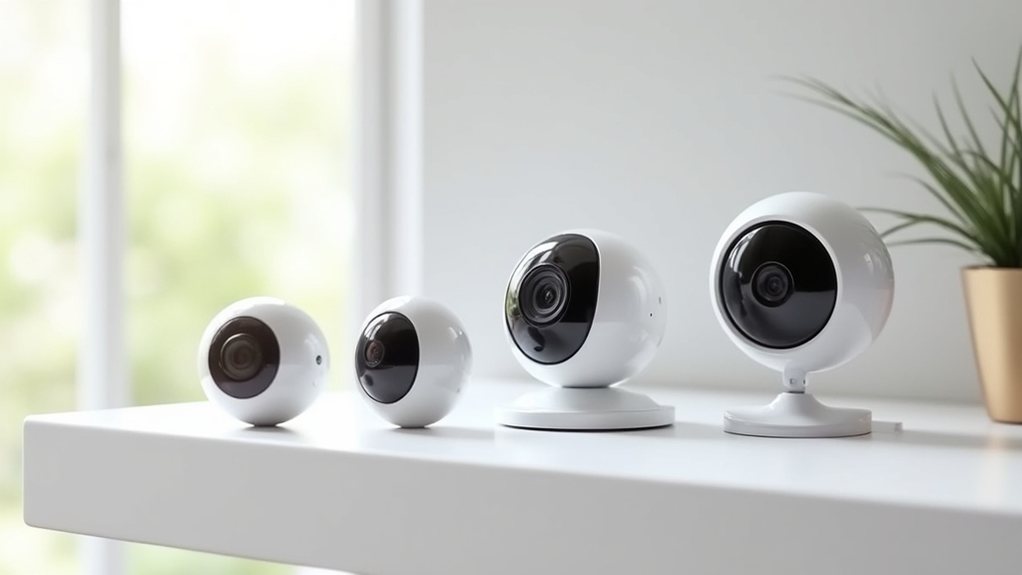
Home security can give you peace of mind, but not all cameras deliver on their promises. You’ve probably seen countless options online, each claiming to be the ultimate solution for keeping your property safe. With varying features like battery life, video quality, and weather resistance, how do you determine which system actually merits your investment? The right camera doesn’t just record—it deters potential threats and provides reliable alerts when you need them most. Let’s explore three standout options that consistently outperform the competition.
Blink Outdoor 4 Wireless Security Camera System (2 Cameras)


If you’re seeking reliable, hassle-free home surveillance without worrying about constant battery changes, the Blink Outdoor 4 Wireless Security Camera System stands out with its impressive two-year battery life. This wireless system delivers crisp 1080p HD video with a 143° diagonal field of view, guaranteeing extensive coverage of your property.
You’ll appreciate the system’s improved motion detection with dual-zone alerts sent directly to your smartphone. It’s also Alexa-compatible, allowing for convenient voice commands and multi-camera viewing. While cloud storage requires a subscription after the 30-day trial, you can opt for local storage with additional Blink components, offering flexibility for your security needs.
Best For: Homeowners seeking a low-maintenance, wire-free security solution with extended battery life and flexible installation options for outdoor monitoring.
Pros:
- Impressive two-year battery life eliminates frequent maintenance and battery replacements
- Wide 143° field of view with 1080p HD quality provides comprehensive coverage of your property
- Enhanced motion detection with smartphone alerts and Alexa integration offers convenient monitoring options
Cons:
- Cloud storage requires a subscription after the initial 30-day free trial period
- Local storage options require additional purchases (Sync Module XR with MicroSD card or Sync Module 2 with USB drive)
- Limited photo resolution of 640 x 360 compared to the higher quality video resolution
Blink Outdoor 4 Wireless Smart Security Camera (3 Camera System)

Security-conscious homeowners seeking hassle-free monitoring will appreciate the Blink Outdoor 4’s impressive two-year battery life. This three-camera system delivers 1080p HD video with a generous 143° diagonal field of view, allowing you to monitor multiple entry points simultaneously.
You’ll find setup straightforward with the included Sync Module Core and mounting kits. The system excels in harsh weather conditions, operating between -4 to 113°F. When you’re away, utilize the improved dual-zone motion detection and optional person detection features through the Blink app. The system’s compatibility with Alexa enables convenient voice commands and multi-camera live viewing, simplifying your home security management.
Best For: Homeowners who need a weather-resistant, wire-free security system with minimal maintenance requirements and multiple camera coverage for different areas of their property.
Pros:
- Exceptional two-year battery life eliminates frequent battery changes and maintenance
- Wide 143° field of view with 1080p HD resolution provides comprehensive coverage of entryways and property perimeters
- Weather-resistant design withstands extreme temperatures from -4° to 113°F, making it suitable for year-round outdoor use
Cons:
- Person detection feature requires an additional subscription plan
- Limited to 2.4 GHz Wi-Fi networks only, which may be problematic in homes with newer dual-band routers
- Cloud storage requires a subscription after the 30-day trial ends, though local storage options are available with additional purchases
Blink Outdoor 4 XR Wireless Security Camera (4 Camera System)

Homeowners with large properties or challenging Wi-Fi environments will appreciate the Blink Outdoor 4 XR system, which offers an impressive 1000-foot open-air range—four times greater than standard Wi-Fi cameras. The four-camera package includes everything you’ll need: cameras, Sync Module XR, batteries, and mounting kits.
You’ll enjoy 20% faster live view access and 70% fewer disconnections thanks to the 900MHz XR technology that bypasses Wi-Fi congestion. With two-year battery life and flexible storage options—cloud-based or local with a MicroSD card—you’re covered for the long haul. Plus, Alexa compatibility lets you control your system with voice commands for a truly integrated smart home experience.
Best For: Homeowners with large properties, rural areas, or homes with Wi-Fi dead zones who need a reliable, long-range wireless security camera system with minimal maintenance requirements.
Pros:
- Exceptional 1000-foot range with XR technology provides 4x the coverage of standard Wi-Fi cameras, ideal for large properties
- Two-year battery life eliminates frequent battery changes and maintenance headaches
- Flexible storage options allow for both cloud-based subscription or local storage via MicroSD card (sold separately)
Cons:
- MicroSD card for local storage must be purchased separately
- Initial setup may be more complex than single-camera systems due to multiple devices
- Subscription required to unlock full cloud storage capabilities beyond the 30-day trial period
Factors to Consider When Choosing Smart Home Security Cameras
When you’re selecting the perfect smart home security camera for your needs, you’ll want to evaluate several critical factors that can make or break your experience. The resolution and video quality will determine how clearly you can identify faces and details, while battery life, storage options, connectivity range, and installation complexity will affect your camera’s long-term usability and convenience. You’ll need to weigh these elements carefully against your specific security requirements, budget constraints, and technical comfort level to find the ideal surveillance solution for your home.
Resolution and Video Quality
While many factors influence a security camera’s effectiveness, resolution and video quality stand at the forefront of your purchasing decision. Most home security needs are well-served by 1080p HD cameras, but if you need to capture fine details like facial features or license plates, consider investing in 4MP or 4K models.
Your camera’s field of view is equally important—wider angles around 143° diagonal mean you’ll need fewer cameras for complete coverage. Don’t overlook frame rate; 30 fps delivers the fluid video necessary for capturing quick movements without blurring. For round-the-clock protection, infrared night vision is crucial, allowing your camera to maintain clarity even in complete darkness. When you’re evaluating options, remember that these video quality specifications directly impact your system’s ability to provide meaningful security footage.
Battery Life Duration
A reliable security camera quickly becomes worthless if its battery dies at critical moments. You’ll want to prioritize models offering extended power longevity, with some premium options providing up to two years of operation between changes.
AA lithium batteries typically outperform standard alkaline options in security applications, especially in outdoor installations. Be mindful that environmental conditions considerably impact performance—extreme temperatures and frequent motion triggering will drain your batteries faster than advertised.
If you’re utilizing cloud storage features, expect more frequent battery replacements due to increased data transmission demands. Consider investing in cameras with energy-saving features like customizable motion zones or scheduled recording times. Some newer models offer solar charging capabilities or low-power connectivity protocols that greatly extend operational life without sacrificing performance. The right battery configuration guarantees your property remains protected when it matters most.
Storage Options Available
Beyond battery considerations, storage capabilities determine how you’ll access and retain your security footage. Most smart cameras offer cloud storage with free trials of subscription plans, providing convenient access to your videos from anywhere. These cloud options typically store footage for up to 60 days, though you’ll face recurring fees after the trial period.
If you’d prefer avoiding subscriptions, look for cameras with local storage options. Many systems support MicroSD cards or USB drives, giving you greater capacity without monthly costs. You’ll just need to purchase the storage device once. Consider how each option affects your ability to save and share clips—a vital feature if you need footage for security incidents or legal purposes. Your choice ultimately balances convenience against long-term expenses, with cloud offering accessibility while local storage provides independence.
Connectivity and Range
Reliable connectivity forms the foundation of any effective security camera system, determining whether you’ll capture crucial footage or face frustrating gaps in coverage. When selecting your cameras, prioritize models that operate on a stable 2.4 GHz Wi-Fi network for optimal performance. Consider the camera’s range capabilities—premium options offer impressive coverage up to 1000 feet in open areas and 400 feet in typical home environments.
For homes in densely populated areas, look for systems utilizing 900MHz frequency to bypass Wi-Fi congestion, delivering up to 70% more reliable connections with fewer dropouts. You’ll also want to assess how many devices the system can support if you’re planning extensive coverage with multiple cameras. Remember, your security system is only as strong as its weakest connection.
Installation Complexity Level
While robust connectivity guarantees your security system captures every moment, the practical reality of getting cameras up and running deserves equal attention. You’ll find notable variation in how complicated different security cameras are to install.
Wireless models typically offer the most straightforward setup experience—many can be mounted and connected to your network within minutes. Look for systems that include mounting hardware and long-lasting batteries (ideally with two-year lifespans), as these eliminate the need for nearby outlets and complex wiring.
Consider whether you’re comfortable handling the installation yourself or if you’d prefer a professional touch. Some advanced systems require additional configuration for cloud storage or smart home integration. Remember, the complexity of installation directly impacts your satisfaction with the system, so choose a solution that aligns with your technical comfort level.
Weather Resistance Rating
The harsh elements of nature pose a considerable challenge for outdoor security cameras, making weather resistance ratings vital for your investment’s longevity. When evaluating options, pay close attention to the IP (Ingress Protection) rating—a standardized measure that indicates how effectively your camera can withstand environmental conditions. For reliable performance in wet weather, you’ll want cameras rated IP65 or higher, which guarantees they’re completely dust-tight and can handle low-pressure water jets from any direction.
Don’t overlook the operational temperature range, typically between -4°F to 113°F (-20°C to 45°C). This specification determines whether your camera will function properly during summer heat waves or winter freezes. By selecting cameras specifically designed for outdoor use, you’ll markedly improve durability against rain, snow, and temperature extremes, ultimately reducing replacement costs and maintenance headaches.
Smart Home Integration
Seamless integration with your existing smart home ecosystem should rank high on your priority list when selecting security cameras for modern living spaces. Today’s advanced cameras offer voice control compatibility with platforms like Alexa, allowing you to check your home’s security with simple commands.
Look for cameras that support multi-device connectivity, enabling your security system to work in concert with other smart devices throughout your home. Some cutting-edge models utilize XR technology, which provides more stable connections than traditional Wi-Fi-dependent systems. You’ll also benefit from automated routines—your system can arm itself when you leave and disarm upon your return. When evaluating storage options, prioritize systems offering both cloud and local backup capabilities, giving you flexibility in how you manage and access your security footage.
Final Thoughts
You’ll find that Blink’s lineup offers exceptional options for every security need. Whether you’re protecting multiple entry points with the standard Outdoor 4, covering expansive property with the XR’s extended range, or weathering harsh conditions with the durable three-camera system, there’s a solution that fits your home. Consider your specific requirements—battery life, coverage area, and environmental factors—before investing in the smart security that’ll keep your property protected around the clock.