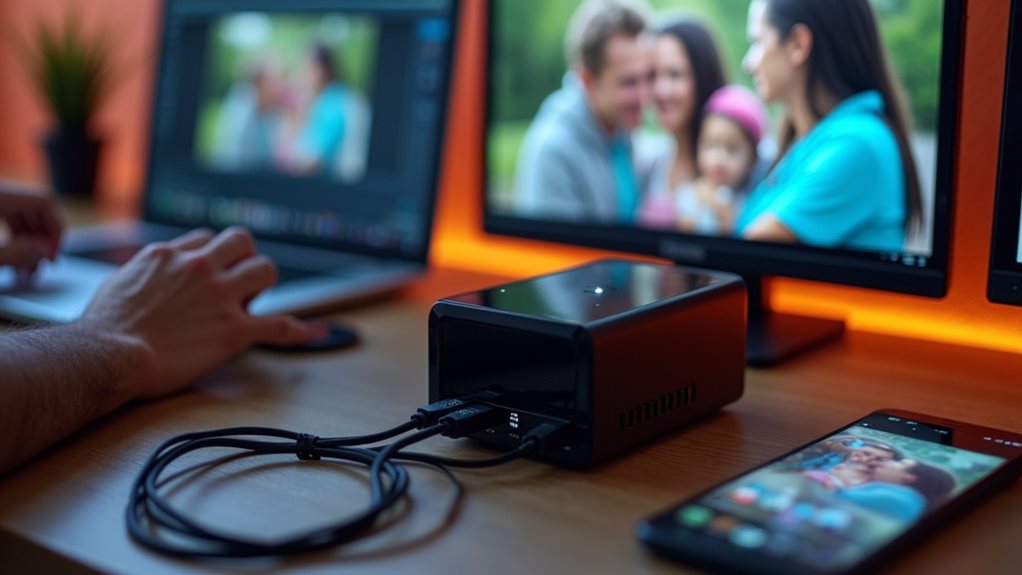
A NAS (Network Attached Storage) provides centralized file storage that you can access from any device on your network. You’ll benefit from automated backups, media streaming to TVs and devices, and protection against data loss through redundant storage options. It eliminates scattered files across multiple computers and external drives while offering remote access to your content when away from home. The cost-effective expandable storage grows with your needs as your digital library expands.
Centralized File Storage and Management
One of the primary reasons to invest in a Network Attached Storage (NAS) device is the ability to centralize all your digital files in a single location.
This centralization eliminates the chaos of storing files across multiple computers, external drives, or cloud services.
With a NAS, you’ll create a unified library where documents, photos, videos, and other media are organized in one system.
A unified digital library at your fingertips, consolidating your entire media collection in one organized, accessible system.
Your files remain accessible to any authorized user or device on your network without the need to transfer data physically between computers.
You can implement consistent file naming conventions, folder structures, and access permissions across your entire digital collection.
This organization makes finding specific files much easier while reducing duplicate data that might otherwise consume valuable storage space.
A NAS also simplifies backup procedures since you’re protecting a single repository rather than multiple scattered storage locations.
Seamless Access From Multiple Devices
A key advantage of your NAS is the ability to access your files from any device, regardless of its operating system or location.
You’ll enjoy streaming movies, music, and photos to your smart TV, phone, or tablet without the compatibility issues that often plague direct device-to-device sharing.
Your NAS serves as a centralized data hub, allowing your laptop, desktop, and mobile devices to seamlessly connect to the same library of documents, media, and backups.
Device-Agnostic File Sharing
When you own multiple devices like laptops, smartphones, and tablets, accessing your files seamlessly becomes essential. A NAS solves this problem by providing device-agnostic file sharing capabilities.
Unlike platform-specific solutions, your NAS doesn’t care if you’re using Windows, macOS, iOS, or Android. You can access the same files from any operating system without compatibility issues or format conversions.
This universal accessibility means you won’t need to email files to yourself or use USB drives when switching between devices. Your documents, photos, and videos remain in one central location, accessible through standard file protocols that work across all modern systems.
The NAS handles the technical differences between platforms behind the scenes, presenting your files in a consistent way regardless of which device you’re currently using.
Cross-Platform Media Streaming
Three key benefits make NAS devices perfect for media streaming across different platforms. A NAS allows you to access your entire media library regardless of which device you’re using, eliminating compatibility issues that often plague direct device-to-device transfers.
Your media collection becomes available anywhere in your home through:
- Universal protocol support that works with Windows, macOS, iOS, and Android devices simultaneously
- Dedicated apps from manufacturers that optimize streaming quality based on your connection speed
- DLNA/UPnP compatibility that enables smart TVs and game consoles to access your content directly
This cross-platform functionality means you don’t need separate storage solutions for different ecosystems. Your photos, music, and video libraries remain consistent across all your devices, with the NAS handling format conversion and bandwidth management behind the scenes.
Centralized Data Hub
Beyond streaming media, the true power of NAS devices emerges through their function as centralized data hubs.
Your NAS serves as a unified location for all digital files, accessible from any device on your network. Whether you’re using a Windows laptop, Mac desktop, Android phone, or iPad, you’ll have consistent access to your important documents.
This centralization eliminates the frustration of searching across multiple devices for specific files. You won’t need to email documents to yourself or carry USB drives between computers anymore.
Many NAS systems offer mobile apps that extend this connectivity beyond your home network. You can securely access your centralized data even while traveling or at work, providing flexibility without sacrificing organization.
For families and small businesses, this seamless multi-device access creates a practical foundation for collaboration and file sharing.
Automated Data Backup and Recovery
One of the most compelling reasons to invest in a NAS is its ability to automate your data backup processes.
You’ll never need to worry about manually copying important files again, as your NAS handles this task in the background.
NAS systems offer several backup advantages:
- Scheduled backups – Set your preferred frequency (hourly, daily, weekly) and let the system work automatically without intervention.
- Version control – Many NAS solutions maintain multiple file versions, allowing you to recover previous iterations if needed.
- Recovery options – In case of data loss, you can restore files from your most recent backup with just a few clicks.
Most modern NAS devices also include disaster recovery features that create backups to external drives or cloud services, guaranteeing your data remains safe even if your physical NAS encounters problems.
Media Streaming and Entertainment Hub

Your NAS can transform your home entertainment experience by serving as a centralized storage hub for all your movies, TV shows, music, and photos.
You’ll enjoy multi-device access to your media collection from smart TVs, tablets, phones, and computers anywhere in your home network or even remotely when properly configured.
Most modern NAS systems support seamless 4K video streaming with specialized media server applications like Plex or Emby, eliminating buffering issues you might experience with cloud-based services.
Centralized Content Storage
Streaming services transform how we consume media, but a NAS takes entertainment to another level by creating a centralized hub for all your digital content.
With a single dedicated storage location, you’ll never wonder where that movie or music collection is hiding again.
A NAS provides three key advantages for content management:
- Accessibility – Access your files from any device on your home network without transferring copies
- Organization – Create custom folder structures and tagging systems that make sense for your specific needs
- Consolidation – Bring together content scattered across external drives, computers, and cloud services
This centralized approach eliminates the frustration of searching multiple devices for specific files.
Your NAS becomes the definitive location for everything digital, from family photos to downloaded movies, creating a streamlined content ecosystem throughout your home.
Multi-Device Access Anywhere
While traditional media setups often restrict content to a single viewing location, a NAS transforms your home into a connected entertainment ecosystem where every device can access your digital library.
Your NAS serves as a central media server that streams movies, shows, music, and photos to any connected device in your home. You can watch a movie on your smart TV, pause it, and continue watching from your tablet in another room without missing a beat.
This multi-device access extends beyond your home’s walls. With proper configuration, you can securely access your content while traveling or at work. Many NAS systems offer dedicated mobile apps that let you stream your media collection from anywhere with an internet connection.
For families, this means everyone can enjoy different content simultaneously without conflict over physical media or viewing locations.
Seamless 4K Video Playback
Modern NAS systems deliver exceptional 4K video playback capabilities that transform your home entertainment experience.
These dedicated storage solutions provide the bandwidth and processing power needed for seamless, buffer-free streaming of high-resolution content throughout your home.
Your NAS can function as a complete media hub with these key advantages:
- Direct streaming to smart TVs, gaming consoles, and mobile devices without transcoding delays
- Support for popular media server applications like Plex, Emby, and Jellyfin that organize your library
- Hardware acceleration capabilities that handle multiple simultaneous 4K streams to different devices
You’ll appreciate the convenience of having all your movies, TV shows, and personal videos centralized in one location.
Many NAS units also support HDR content and advanced audio formats, delivering a premium viewing experience comparable to commercial streaming services.
Cost-Effective Storage Expansion
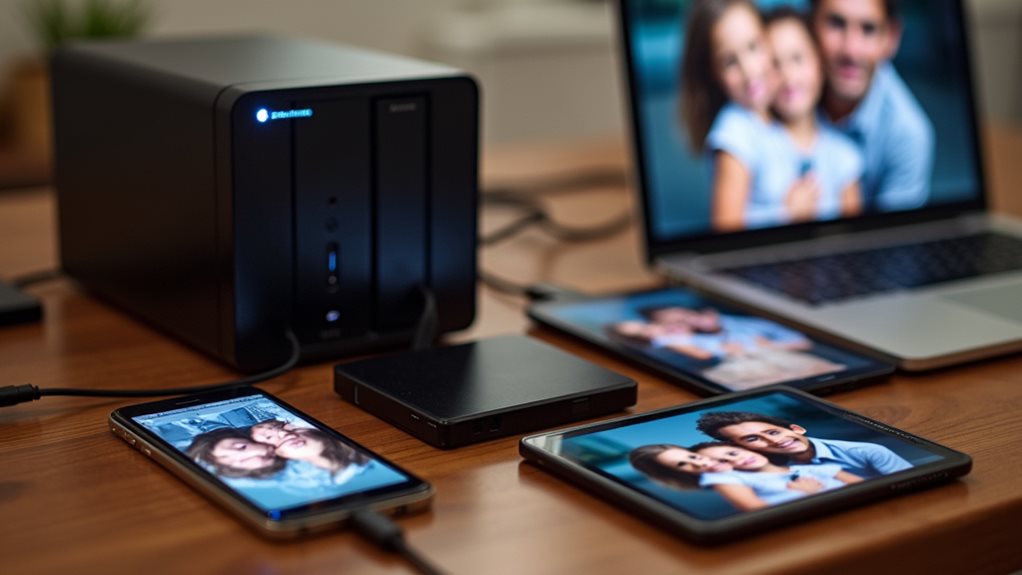
Despite common assumptions, a NAS system isn’t always the most cost-effective storage solution for everyone. The initial investment can range from $200 for basic models to over $1,000 for more robust systems, not including hard drives.
NAS devices may cost more upfront than you expect, with entry models starting at $200 plus the cost of drives.
However, when you need to expand storage capacity, NAS devices offer considerable long-term value. You can gradually add or replace drives as your needs grow, avoiding the complete replacement costs associated with external drives.
Many NAS systems support multiple drive configurations that optimize both cost and data protection. For example, using RAID 5 allows you to lose one drive without losing data while maximizing available storage.
For businesses, a NAS can eliminate recurring cloud storage subscription fees, potentially saving thousands of dollars annually while maintaining complete control over your data.
Enhanced Data Security and Protection
Security concerns for your digital assets make NAS systems particularly valuable. Modern NAS solutions offer multiple layers of protection that standard external drives can’t match.
Your NAS provides crucial security benefits:
- Automatic backup capabilities including RAID configurations that protect against drive failure by mirroring data across multiple disks.
- Encryption options that safeguard your files from unauthorized access, both during transmission and while stored.
- Ransomware protection features through versioning systems that maintain previous file copies, allowing you to restore data even after malicious encryption.
Unlike simple external drives, a NAS can implement thorough access controls with individualized user permissions.
You’ll also benefit from scheduled backups that run without manual intervention, guaranteeing your most recent work is protected even when you forget to initiate backup processes yourself.
Remote Access to Your Files From Anywhere

While traditional storage solutions keep your files locked to one location, NAS systems excel at providing access to your data regardless of where you are.
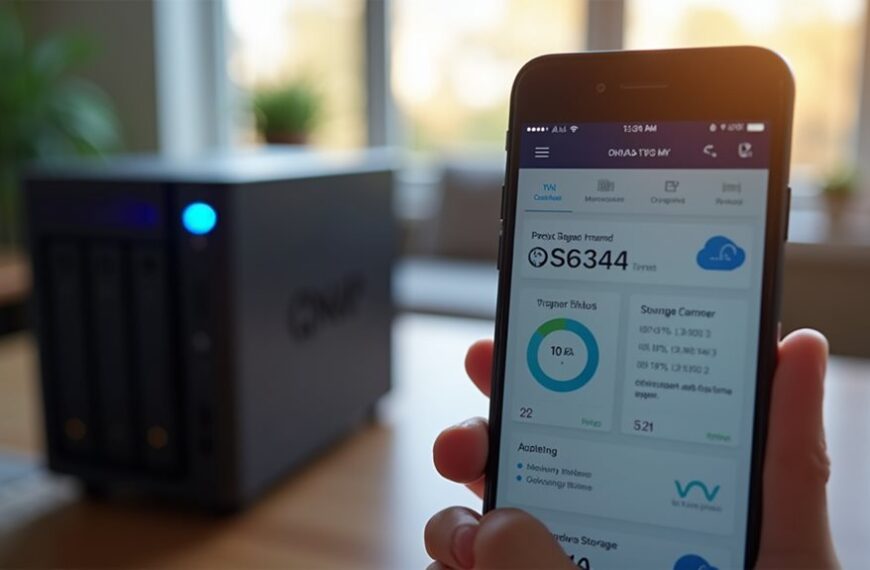
Most NAS devices include built-in remote access features that let you connect to your files through secure web portals or dedicated mobile apps.
You’ll appreciate the convenience of accessing important documents during business trips or retrieving vacation photos while visiting family.
Modern NAS systems offer straightforward setup procedures that simplify the configuration of remote access without extensive technical knowledge.
These devices typically include encrypted connections that protect your data as it travels across the internet.
Many NAS manufacturers provide free companion apps that optimize the viewing experience for different file types on various devices, from smartphones to tablets.
Business Applications and Productivity Benefits
NAS systems offer three key advantages for businesses of all sizes. They provide centralized data management that streamlines workflows and reduces bottlenecks, allowing your team to collaborate more efficiently.
Centralized NAS solutions eliminate workflow barriers, enhancing team productivity through streamlined data management.
A NAS deployment improves your business operations through:
- Simplified file sharing and collaboration, enabling multiple employees to access and edit documents simultaneously without version control issues.
- Automated backup solutions that protect critical business data from loss due to hardware failure or user error.
- Scalable storage capacity that grows with your business needs without requiring complete system overhauls.
Frequently Asked Questions
How Much Power Does a Typical NAS Consume Monthly?
A typical NAS consumes between 10-30 watts continuously, translating to 7-22 kWh monthly. You’ll spend roughly $1-3 on electricity, depending on your model’s efficiency and your local electricity rates.
Can I Run Virtual Machines Directly on My NAS?
Yes, you can run virtual machines on your NAS if it has sufficient processing power and RAM. Many modern NAS devices support virtualization through software like Docker or dedicated VM applications, enabling additional functionality directly from your storage device.
What’s the Typical Lifespan of a Consumer NAS Device?
You can expect your consumer NAS to last 3-5 years with proper maintenance. The drives inside typically fail first, but you’ll likely replace them before the actual device becomes obsolete or breaks down.
Is NAS Noise Level Suitable for Bedroom or Living Room Placement?
Your NAS noise level depends on the model. Fanless options are silent, perfect for bedrooms. Standard NAS devices with cooling fans create a light hum, which you might notice in quiet living spaces.
Can I Use Drives From Different Manufacturers in the Same NAS?
Yes, you can use drives from different manufacturers in the same NAS. However, it’s best to use similar specs (capacity, speed, cache) to optimize performance and avoid potential compatibility issues.
Final Thoughts
You’ll find a NAS offers tremendous value beyond simple storage. It centralizes your digital life, providing seamless access to files across all your devices while automating critical backups. You’re getting improved security, remote accessibility, and a cost-effective way to expand storage as your needs grow. For homes and businesses alike, a NAS delivers noteworthy organizational benefits that simplify data management and boost productivity.