AI search tools can influence which brands people discover when they ask for recommendations, comparisons, or solutions. CitedSpy is a brand visibility platform designed to show whether and how a business appears in AI-generated responses across platforms such as ChatGPT, Gemini, Copilot, and Google AI Mode.
Rather than treating AI visibility as a vague marketing goal, the platform centers the work on tracked prompts, brand citations, competitor performance, reports, and recommended actions. It also includes a content workflow for producing articles intended to improve discoverability in AI search.
Click to access the Lifetime deal
What Is CitedSpy?
CitedSpy is an AI visibility monitoring and optimization tool. A business starts by adding its website, after which the platform suggests relevant prompts to track based on the site’s content. Those prompts form the basis of ongoing analysis across supported AI platforms.
The core purpose is to help marketers answer practical questions such as:
- Is the brand mentioned when people ask AI tools about this category?
- Which prompts produce a brand mention, citation, or competitor recommendation?
- Which competitors are receiving more visibility?
- What sources may be helping competing brands appear in responses?
- What off-site, technical SEO, or content actions could improve the brand’s position?
This makes CitedSpy most relevant to businesses that rely on online discovery, as well as agencies that manage visibility reporting for multiple clients.
How AI Visibility Tracking Works
The quality of AI visibility analysis depends heavily on the prompts being monitored. A generic prompt can be useful for broad category awareness, but specific commercial and informational questions are often more actionable.
CitedSpy’s onboarding suggests prompts from the website supplied during setup. These can then be accepted and used to create an initial report. Results are generated for the supported AI services, allowing a business to compare its presence across multiple AI environments rather than relying on one model alone.
Choose prompts that reflect real customer questions
Before treating any visibility score as meaningful, review the prompt set. A useful prompt list should include a mix of questions that reflect the customer journey:
- Category prompts: Questions about the overall type of product or service.
- Recommendation prompts: Queries asking for the best solutions in a category.
- Comparison prompts: Questions that compare brands, platforms, or approaches.
- Problem-solving prompts: How-to questions that a potential customer may ask before buying.
- Brand prompts: Searches that test whether the AI can accurately describe a particular company or offering.
For example, a marketing software business might monitor a recommendation prompt about all-in-one marketing solutions, a comparison prompt involving alternative tools, and a how-to prompt related to a customer problem it solves.
Prompt selection is not a one-time task. When a business changes its positioning, products, audience, or website, the prompts should be reviewed and refreshed so the monitoring reflects the current strategy.
Understanding the CitedSpy AI Visibility Score
The dashboard presents an AI visibility score out of 100 for a selected reporting period. This provides a high-level starting point for understanding whether the brand is appearing in the tracked AI answers.
A score is useful for tracking movement over time, but it should not be treated as a standalone business metric. The more useful analysis sits beneath the total:
- Which tracked prompts are working well?
- Where are competitors winning?
- Is the brand cited as a source, merely mentioned, or absent?
- Which AI platforms show the largest opportunity?
- Are results improving after content, citation, or technical changes?
In other words, use the visibility score as a directional indicator. The prompt-level data and source information are what help turn the number into a marketing plan.
Brand mentions and citations are not the same thing
A brand mention indicates that the business appears in an answer. A citation is more specific: the AI response refers to a source associated with the brand or uses it as supporting material. Both can matter, but citations can be especially valuable because they signal a clearer connection between the brand and the topic.
CitedSpy includes citation-related reporting and identifies brand and competitor performance. The platform also provides a tracking pixel that can be installed to help track sources going forward.
External coverage may support citation opportunities. For example, press releases were identified as one way a brand may gain citations. This should not be interpreted as a guarantee that a press release will result in AI citations. It is one potential source-building tactic within a broader visibility strategy.
Competitive AI Visibility Analysis
AI search is competitive. When a brand does not appear in a response, another brand often does. CitedSpy surfaces competitor wins alongside positive brand outcomes, allowing marketers to identify who is receiving visibility for the prompts that matter most.
Competitive reporting can help answer:
- Which competitors are repeatedly included in recommendations?
- Which prompts lead to competitor citations?
- Where does the brand have no presence at all?
- Which topics may require stronger on-site pages or third-party references?
The goal is not to copy a competitor’s language or publish thin imitations of their pages. Instead, look for patterns. If competitors are consistently associated with a topic, build genuinely useful material that clearly explains your relevant expertise, product, or service.
From AI Visibility Data to Practical Actions
A useful monitoring platform should do more than report a problem. CitedSpy includes an Action section that produces potential off-site actions after a workspace sweep. These may include opportunities connected with videos, websites, and existing online discussions.
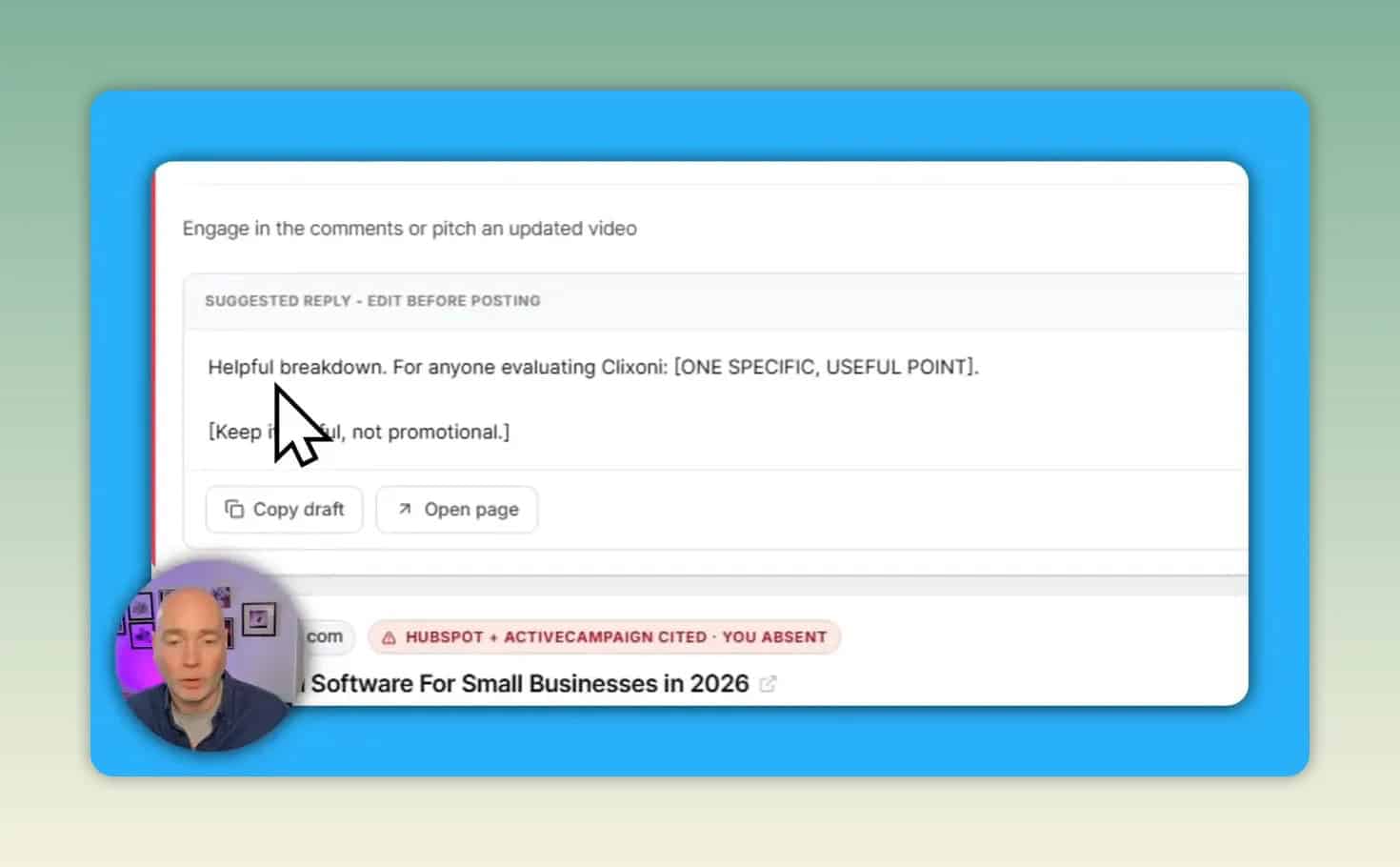
For a relevant video or article, the platform can generate a draft engagement response. The suggested copy is a starting point, not something to paste repeatedly across the web.
Use engagement drafts responsibly
Generic, duplicated comments can harm credibility and may be treated as spam. If an action suggests engaging with a publisher, creator, or community, use a careful process:
- Check relevance. Only engage where the subject clearly overlaps with your expertise or offer.
- Read the original content. Do not respond to a title or summary alone.
- Rewrite the draft. Add a specific, useful point that fits the discussion.
- Lead with value. Explain, clarify, or contribute something genuinely helpful.
- Avoid forced promotion. A brand mention or link should be appropriate, not the sole purpose of the response.
The same principle applies to outreach for website mentions. A relevant request backed by a helpful resource has more value than mass outreach using identical templates.
Do not overlook technical SEO
CitedSpy also includes a technical SEO report. This matters because clear, accessible website content remains foundational to online visibility. Technical issues can make it harder for search systems and users to access, understand, and trust a site.
Use technical findings as a checklist for your web team. Then connect fixes to the tracked prompts: improve the pages that best answer the high-priority questions your audience is asking.
Create Content for AI Discovery With the Built-In Writer
CitedSpy includes a content creation workflow that can generate new content or optimize existing pages. Available options include creating new content, optimizing pages, or generating an outline structure before producing a complete article.
The workflow supports several content types, including blog posts and how-to content. It carries suggested prompts into the process, so a marketer does not need to manually reconstruct the topic research already completed during tracking.
A practical content production process
- Select a high-value prompt. Prioritize topics where the business lacks visibility or where competitors frequently appear.
- Define the audience. Specify who needs the content and what they need to accomplish.
- Set a clear angle. Choose the problem, perspective, or use case that makes the article useful.
- Review the outline. Check the title, answer-first opening, and proposed sections before drafting.
- Improve the completed draft. Add accurate business details, subject expertise, examples, and original insight.
- Add visuals before publishing. The content workflow does not generate a featured image or body images, so these need to be created and added separately.
- Export in the needed format. Generated content can be downloaded as Markdown or HTML.
The generated article receives a GEO score, along with signals such as entity coverage. These indicators can help guide optimization, but they should not replace editorial judgment. A high score does not guarantee that a page is accurate, differentiated, helpful, or ready to publish.
Common AI Visibility Mistakes to Avoid
Tracking prompts that do not match your business
Suggested prompts save time, but they still need human review. Remove queries that are irrelevant, too broad, or based on an old business model. Add prompts that reflect your current offer and target customer.
Obsessing over a single score
A total visibility score can conceal important variation. A brand may perform well on informational questions but fail to appear in recommendation prompts. Review individual prompts and AI platforms before deciding what to change.
Publishing generated copy without editing
Content generation can accelerate planning and drafting, but it is not a substitute for fact-checking, positioning, and expert review. Add the details that only the business can provide and ensure every claim is accurate.
Using the same engagement response everywhere
Draft engagement suggestions should be personalized. Repeated comments can look inauthentic and are unlikely to build meaningful associations between a brand and its topic area.
Ignoring changes to your website or positioning
If the website, product offering, or target market changes significantly, rerun setup or revise prompt tracking. Continuing to measure outdated prompts produces less useful insights.
Who Should Consider CitedSpy?
CitedSpy has a clear fit for two types of users:
- Single businesses: Lower tiers are suited to organizations monitoring one brand, one workspace, and one seat.
- Agencies: Higher tiers add capacity and agency-oriented features for multiple brands, workspaces, team members, and client reporting.
The plans shown range from $79 to $799. Higher tiers add capabilities such as more brands and workspaces, additional seats, Slack and webhook alerts, MCP access, Looker Studio access, API access, white-label dashboards, custom domains, competitive tracking, more prompt research, and article generation.
Agency users can configure white labeling by adding a logo, name, brand color, and email address. White-label use can also include a custom domain, such as a branded subdomain for client access. A usage tracker is available to help agencies understand how their team is using the platform.
Integrations and Reporting Options
For teams that need to bring AI visibility data into their established reporting workflow, CitedSpy supports integrations including Looker Studio, MCP, Zapier, Activepieces, n8n, and Make. API keys are also available.
Reporting options include executive summaries, deep dives, and competitive benchmarks. An executive summary can be downloaded as a PDF or shared through a link, which can be useful for internal updates and client conversations.
Is CitedSpy Worth Using?
CitedSpy is most valuable when it becomes part of a repeatable AI visibility process: choose meaningful prompts, review brand and competitor outcomes, prioritize the strongest opportunities, improve content and technical foundations, and measure changes over time.
It is particularly useful for marketers who need more than raw AI response monitoring. Its combination of prompt tracking, citation analysis, action suggestions, reports, content generation, agency tools, and integrations provides a workflow from measurement to execution.
Before choosing a plan, confirm that the number of brands, workspaces, seats, prompt allowances, and agency features match your requirements. The current offer details are available through the CitedSpy EarlyBird deal page.
Key Takeaway
AI visibility is not simply about appearing more often. It is about appearing accurately for the customer questions that matter, being associated with credible sources, and building content that genuinely answers the needs behind those questions.
CitedSpy provides a structured way to monitor that visibility and identify next steps. The strongest results will come from combining its recommendations with thoughtful prompt strategy, original content, relevant third-party engagement, and ongoing website improvement.