
If the router is the heart of your connected home, how much do you trust it? A new YouGov survey of 16,474 people across 14 European countries suggests the answer depends heavily on where you think your router comes from—and that’s a problem, because many of us aren’t sure.
Commissioned in April 2026, the study found strong European-wide trust in home routers made by European manufacturers, and a clear scepticism toward devices from Russia, China, and, to a lesser extent, the United States. Yet despite those preferences, most consumers can’t confidently identify where popular brands are based, and many assume the router their broadband provider rented them is European-built—even if it isn’t.
What Brits think about where routers are made
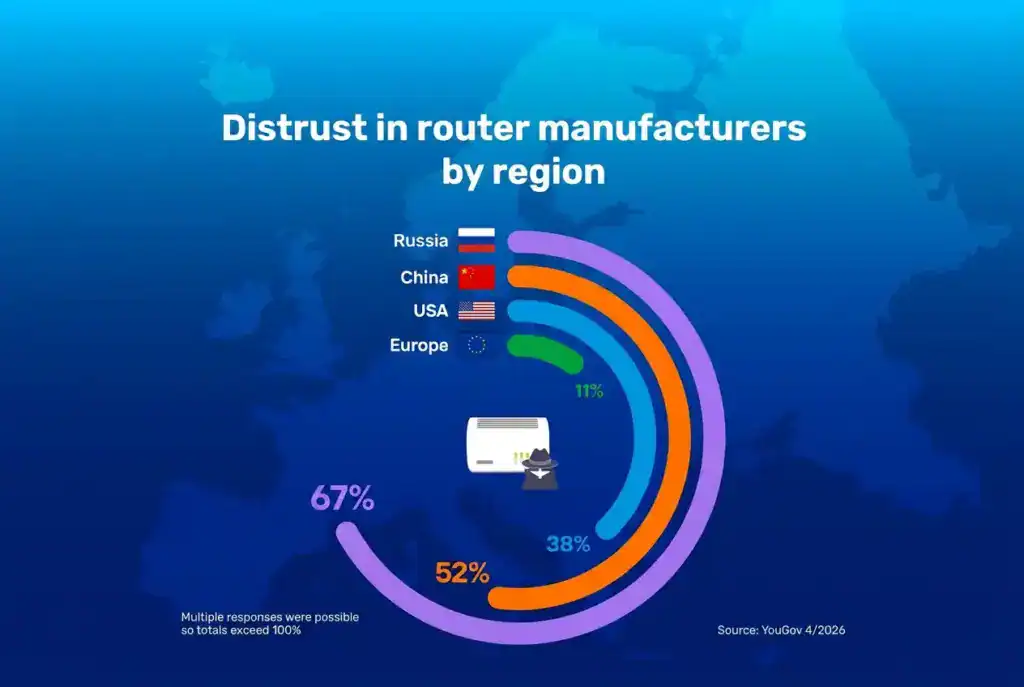
Across Europe, only 10% of respondents expressed mistrust in European router makers, aligning with a broader 60% “high trust” sentiment. By contrast, mistrust is highest toward Russian (67%) and Chinese (52%) manufacturers, with 38% mistrusting US devices.
UK consumers are even more pointed:
- 70% mistrust routers from Russia
- 59% mistrust routers from China
- 36% mistrust routers from the USA
- Only 11% mistrust European manufacturers
In other words, British buyers show a clear preference for European-made networking kit. That dovetails with a broader purchasing signal: more than half of Europeans (55%) say the “Made in Europe” label is important or very important in their buying decisions.
The knowledge gap: we don’t always know our router’s origin
Here’s the twist. While trust skews toward Europe, brand-origin awareness is patchy:
- Only 14% correctly identified TP-Link as Chinese; 16% thought it was European, and 51% weren’t sure.
- Nearly half (49%) were unsure where Netgear hails from.
- Recognition was stronger for Huawei (China, 77%) and Starlink (USA, 55%).
- Europe’s largest router brand, FRITZ!, was correctly identified by just 26% of UK respondents.
That confusion extends to ISP-rented routers. Across all participating countries, most people assume the router their provider supplies is European-made—even when that isn’t the case. The upshot: many households who say they prefer European devices may be using non-European hardware without realising it.
Why this matters for UK households
Routers aren’t just another gadget: they’re the gateway for every device in your home. Trust in the manufacturer often ties back to concerns about data handling, software update policies, supply chain transparency, and long-term security support. If you care about firmware updates, vulnerability response times, and where your data might traverse, knowing the device’s origin (and the brand’s track record) becomes part of a sensible risk assessment.
The survey suggests an intentions–actions gap. UK consumers signal lower trust in certain regions, yet the lack of origin awareness—especially with provider‑supplied equipment—means they may still be running hardware from brands or regions they view less favourably.
The “Made in Europe” effect
With 55% of Europeans rating European development and manufacturing as important, provenance is now a meaningful purchase driver alongside speed, Wi‑Fi standard support (e.g., Wi‑Fi 6/7), coverage, and price. For buyers who value:
- clear security update policies,
- GDPR-aligned data practices, and
- transparent supply chains,
choosing a European manufacturer—or at least a brand with published, verifiable commitments in these areas—can provide added peace of mind.
That said, origin alone isn’t a silver bullet. A robust security posture includes:
- frequent firmware updates and published CVEs,
- independent security audits,
- transparent privacy policies, and
- strong default settings (e.g., unique device passwords, easy patching).
What to do before you buy (or renew your contract)
Whether you’re shopping retail or accepting your ISP’s default router, a few quick checks can align your kit with your preferences:
- Check origin and ownership
- Visit the manufacturer’s official site to confirm headquarters and manufacturing disclosures.
- For ISP-supplied gear, ask your provider the exact model and brand before installation, then look up its origin and support policy.
- Verify update cadence
- Look for a public firmware page with recent releases.
- Check how long the vendor promises security updates (support lifecycle).
- Review privacy and telemetry
- Read the router’s privacy statement. Can you opt out of usage analytics? Are cloud features required or optional?
- Confirm standards and features
- Ensure support for current Wi‑Fi standards (Wi‑Fi 6 or 6E minimum; Wi‑Fi 7 if future‑proofing).
- Look for WPA3 security, guest networks, VLAN support, and easy device isolation.
- Consider total cost of ownership
- ISP routers may seem “free” but could lag on features or updates.
- A one‑off purchase from a trusted brand with strong support may be better value over time.
- Label matters—so does proof
- If “Made in Europe” is important to you, look for clear documentation and independent certifications where available. Pair origin with tangible security practices.
Methodology in brief
- Representative online poll by YouGov in April 2026
- 16,474 respondents aged 18+ across 14 European countries: Germany, Austria, Switzerland, Italy, the Netherlands, Belgium, the United Kingdom, Spain, France, Denmark, Sweden, Norway, Finland, and Poland
- Stratified by age, gender, and region in each country; results weighted to be nationally representative
Bottom line
UK consumers clearly favour European-made routers and express caution toward devices from Russia, China, and the US. Yet with widespread uncertainty about brand origins—especially for ISP‑provided hardware—many homes may be running kit that doesn’t match their preferences. If trust, privacy, and long‑term security support matter to you, take a moment to verify the origin, update policy, and privacy stance of your next router. A few checks now can pay off with a safer, more transparent network for years to come.